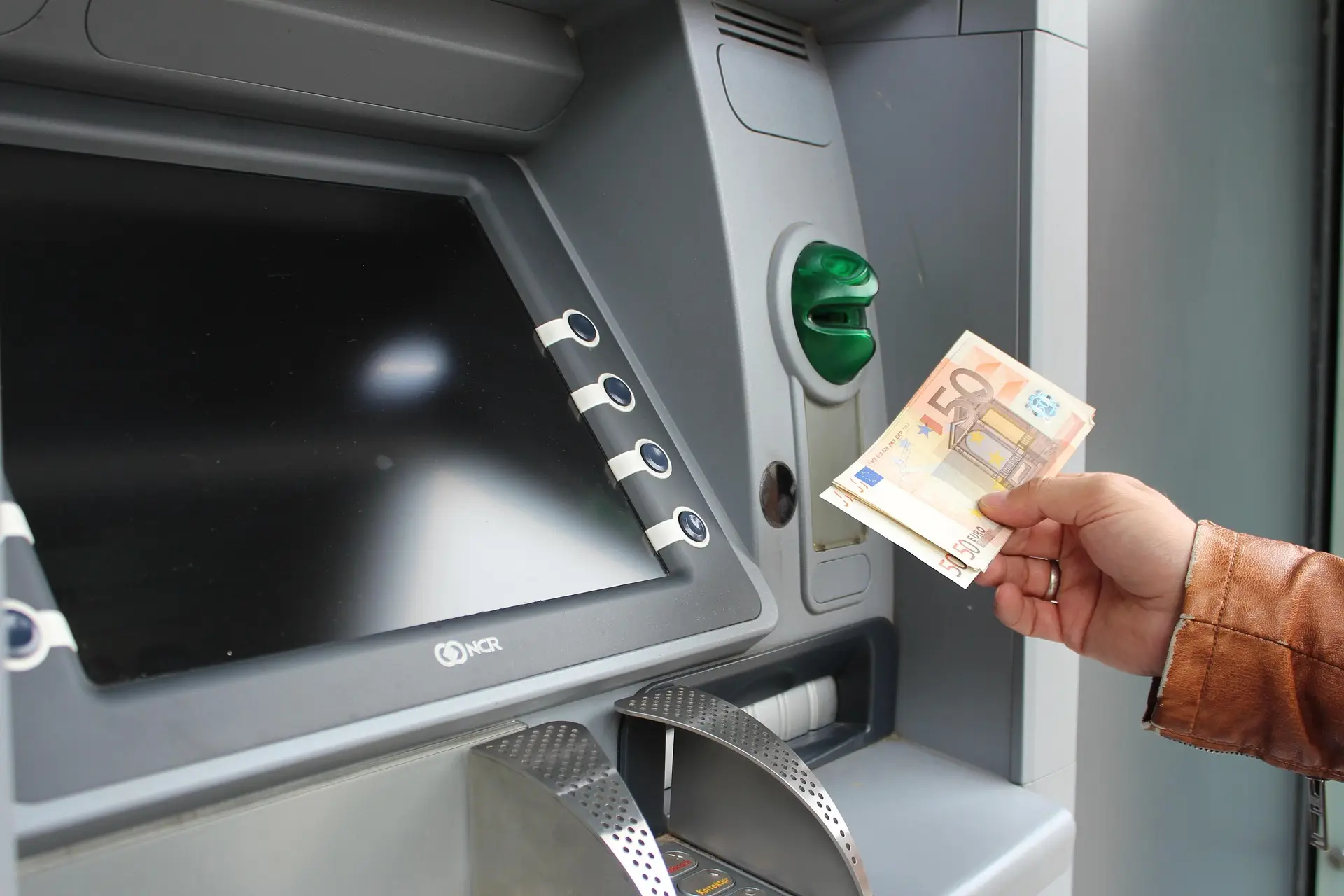
A bitcoin ATM looks like a cash machine and works the other way round: you feed in banknotes and get cryptocurrency. Switzerland has somewhere between 60 and 150 of them, depending on whom you ask – and almost all of those whose operator can be confirmed belong to a single company. They are handy if you want to buy without an account and without waiting. They are also one of the most expensive ways to get bitcoin that we found in Switzerland. This page covers who runs the machines, how many there are in each city, what a purchase costs and how to avoid the most common scam.
Who operates bitcoin ATMs in Switzerland?
The clear market leader is Värdex Suisse AG, based in Zug. The company advertises «80+ ATMs» in Switzerland, plus machines in Liechtenstein, and calls itself the country’s largest crypto ATM network. Värdex is affiliated as a financial intermediary with the self-regulatory organisation VQF. You can buy bitcoin and ether from CHF 50, paying cash in francs or euros or cashless – Värdex lists credit cards, debit cards and TWINT. Only bitcoin can be sold, with payouts in CHF 100 notes. A public status page shows whether the network and back end are running.
The other names on the maps are murkier. Here is what we could and could not confirm:
| Status | What we could confirm | |
|---|---|---|
| Värdex | active | 80+ machines, buys BTC and ETH, sells BTC only, VQF member |
| Bity | unclear | 8 entries on BTC Map, no ATMs left on bity.com |
| «Rothbard» | unclear | 9 entries on BTC Map, an intermediary rather than the operator according to a trade article |
| Bitcoin Suisse | no offer | pioneer from 2014, no ATM page today |
| Kurant | not in Switzerland | Austria, Germany and Spain only |
Neuchâtel-based Bity used to run ATMs in several cities, but its website now only presents a trading desk for professional clients. We could not check whether the machines still listed on BTC Map are working. Behind the «Rothbard» entries in Zurich, Geneva, Lausanne, Lucerne and Basel is, according to a trade article, an intermediary rather than the operator itself. One special case: the House of Satoshi at Langstrasse 136 in Zurich is a bitcoin shop with its own ATM.
How buying at a bitcoin ATM works
The steps below follow Värdex’s help centre. One important point: the machine does not send the coins to your own wallet; it prints a A sheet with a receiving address and the matching private key. Whoever holds the paper holds the coins..
-
Choose the coin
Tap Bitcoin or Ethereum, then «BUY», accept the terms and choose cash or card.
-
Confirm your number
Enter your number with the country code (+41). A one-time code arrives by SMS, which you type in at the machine.
-
Check the rate and confirm
The screen shows the rate including commission. Compare it with the market price now, then press «buy».
-
Wait for the paper wallet
The machine prints the public address and private key. Only carry on once the printout is undamaged.
-
Insert your notes
Pay in francs or euros, at least CHF 50, and confirm the transaction.
-
Keep the receipt
Receipt and paper wallet belong together. Then move the coins into your own wallet without delay.
How to move the balance from the paper into your own wallet is explained step by step on our page about SBB bitcoin paper wallets – the method is the same. Until then, one rule applies: anyone who sees or photographs the A long string of characters that lets you spend coins. Anyone who knows it can empty the balance. can spend your coins. Värdex recommends copying the thermal paper, because the print fades.
What does bitcoin at an ATM cost?
On its product page, Värdex says the ATM rate includes a commission that depends on market conditions and liquidity, and admits its fees may be higher than those of online services. The help centre is more specific: an article there lists a fixed transaction fee of CHF 4 and a commission of 11%, both depending mainly on where the machine is located. From the outside there is no way to tell whether individual machines charge more or less.
Roughly, then, a CHF 500 purchase costs about CHF 59 – nearly 12% of the amount. Buying through an exchange or app by bank transfer typically costs between 0.25% and 1.5%, so between just over one franc and seven francs. In the calculator at the top of this page you can set the markup you see at the machine and get the difference in francs. Other operators publish no fees.
Why so expensive? Värdex points to maintenance, operations, security and compliance. Add site rent, cash transport and fairly small amounts per purchase. You can check the markup on the spot: divide the franc amount by the bitcoin offered and compare that price per bitcoin with the current market price on an exchange. The difference is the The gap between the market price and the price you actually pay – a fee that is not labelled as one. you are paying.
For more than a few hundred francs, an online account funded by bank transfer works out far cheaper.
Operating since 2013Group registered with FinCEN (US) and the FCA (UK)
ID and limits
The legal basis is FINMA’s anti-money-laundering ordinance. Since 2021, financial intermediaries must identify customers once crypto exchange transactions reach CHF 1,000; the threshold used to be CHF 5,000. Linked purchases are added up over 30 days, so paying in CHF 600 on Monday and CHF 600 on Thursday takes you over the line. That is why every ATM has Know Your Customer: the provider verifies your identity, usually with an ID document and a selfie, before you can buy. thresholds.
At Värdex, cash purchases under CHF 1,000 need no registration. For cash, the limit is CHF 1,000 per person every 30 days; for cashless payments, CHF 1,000 per person per day. For larger amounts, Värdex offers Over the counter: buying directly from a provider rather than on an exchange, usually for larger amounts. Exchange Points at third-party counters, where, depending on the location, CHF 20,000 to 50,000 per day is possible. You will need ID, a residence or work permit where applicable and proof of address no older than three months; you pay in cash or by debit card, credit cards are not accepted and each counter sets its own commission.
«No ID» does not mean «anonymous». The SMS code ties every purchase to a Swiss phone number, and even prepaid SIM cards in Switzerland are only registered against ID. The legal background is on our page about FINMA crypto regulation.
Selling bitcoin at an ATM
If you want to turn bitcoin into cash, Värdex is the only ATM buy-back we could confirm. The process according to its help centre:
- At the machine, choose «Bitcoin» and «SELL» and enter the amount in francs. Payouts come in CHF 100 notes.
- Enter your mobile number and confirm the one-time code sent by SMS.
- The machine prints a ticket with a Värdex address and the exact bitcoin amount.
- Send exactly that amount from your own wallet within ten minutes. Värdex advises against sending from exchanges such as Binance, Kraken or Coinbase, as their withdrawals can take too long.
- Wait for blockchain confirmation, 15 to 60 minutes according to Värdex, then collect the cash at the machine.
Sending the wrong amount or sending late can make the transaction fail. All other ways to cash out, from a bank account to an exchange office, are compared in cashing out crypto in Switzerland.
How many bitcoin ATMs are there in Zurich, Geneva, Basel and elsewhere?
There is no reliable, current list, and the two main sources contradict each other. Coin ATM Radar, the largest directory, blocked our requests. We know its figures only second-hand: about 130 ATMs in Switzerland according to a PostFinance blog post, and 149 in an older, undated analysis by HelloSafe, which is also the source of the city figures below. BTC Map, maintained by volunteers, counts only 62 machines tagged as ATMs, including 36 Värdex, 9 «Rothbard», 8 Bity and 3 «TiBc». That is certainly too low, but it often has street addresses.
| City | Coin ATM Radar (older count) | BTC Map | Examples from BTC Map |
|---|---|---|---|
| Zurich | ≈ 41 | 13 | Baslerstrasse 50, Dolder Grand, House of Satoshi |
| Geneva | ≈ 19 | 5 + 4 exchange offices | Rue de Jargonnant 7, Rue de la Servette 49 |
| Lausanne | ≈ 18 | 2 | Bity, Av. William-Fraisse 4 |
| Lugano | ≈ 18 | 5 incl. exchange | one Värdex machine |
| Bern | ≈ 13 | 0 (Biel: 3) | Värdex in Biel/Bienne |
| Basel | ≈ 12 | 5 | 3 Värdex, Feldbergstrasse 100 |
| Zug | ≈ 2 | 1 | Bity, no address |
On BTC Map, St. Gallen, Neuchâtel and Baden follow with two machines each, and Lucerne has one «Rothbard» entry at Friedenstrasse 2. Zug, home of Crypto Valley, has hardly any. If you are searching for «bitcoin ATM Zurich HB»: we know of no dedicated crypto ATM in the station concourse, but every SBB ticket machine sells bitcoin as a paper wallet. All regions at a glance: crypto in the Swiss regions.
Finding an ATM that works
The search works best in three steps. First, Coin ATM Radar or BTC Map for an overview, filtered by city or postcode. Then the operator’s location finder – for Värdex, on vaerdex.ch – for the current address and opening hours, since many machines sit in hotels, shops or shopping centres with limited hours. Finally, Värdex’s status page shows whether the network is up. According to the help centre, an official Värdex machine carries stickers with the company’s address and contact details.
For machines with an unclear operator, look twice: is there a phone number? Terms in a Swiss national language? If not, use another route. Cash alternatives, from SBB ticket machines to the post office counter, are compared in buying bitcoin with cash.
Safety: when someone sends you to an ATM
Bitcoin ATMs are a favourite tool of fraudsters. The pattern is nearly always the same: a caller poses as a police officer, bank employee or tech support, claims your money is at risk and sends you to an ATM with cash. There you are told to pay in and send the coins to a QR code, or to photograph the paper wallet. After that, the money is gone.
- Authorities, banks and support lines never ask for payments into a bitcoin ATM.
- No legitimate person needs a photo of your paper wallet or private key.
- Someone guiding you by phone during the purchase is a red flag – hang up.
- Do not scan QR codes or use addresses that someone has sent you.
- If in doubt, call the police on 117 and talk to someone you trust before moving money.
More schemes, and what to do after a loss, are described in crypto scams in Switzerland.